
The central part of the southern half of the island is mountainous with heights of more than 2500m. The core regions of the central highlands contain many complex topographical features such as ridges, peaks, plateaus, basins, valleys, and escarpments. The remainder of the island is flat except for several small hills in the lowlands. The central hills’ topographical features strongly affect the spatial patterns of winds, seasonal rainfall, temperature, relative humidity, and other climatic elements, particularly during the monsoon season.
There are three conservation projects being in action to preserve mountain forests on central hills concerning the danger of rich biodiverse hotspots where those are Horton Plains National Park, Peak Wilderness Nature Reserve, and Knuckles Mountains range covering an area of 56,844 hectares as highly protected with expanded buffer zone totaling 72,645 hectares listed on the UNESCO World Heritage list on 30th July 2001
Horton Plains National Park [Sinhala- Maha Eliya Thanna – මහ එළිය තැන්න]

Horton plains are located in the central province of Sri Lanka at an altitude ranging from 2100 – 2300 meters (6,900–7,550 ft). Access from Nuwara Eliya is about 32 kilometers and only 8 kilometers from Ohiya. The total area of the National park 3,160 hectares, which commenced in 1988, is controlled and protected by the wildlife department of Sri Lanka.
Geographically located on the southern plateau of the central highlands, encloses by the peaks of Kirigalpoththa [2,389 meters (7,838 ft)] and Thotupola Kanda [2,357 meters (7,733 ft)], the second and the third highest mountains are situated respectively to the west and north. The rocks found in the area belong to the Archaean age and to the high series of the Precambrian era and are made up of Khondalites, Charnockites, and granitic gneisses. The soil type is mainly of the red-yellow podzolic group and the surface layer is covered with decayed organic matter.
Mean annual rainfall greater than 2,000 millimeters (79 inches) followed by frequent cloud cover limits the amount of sunlight to plants, and the mean annual temperature is around 13 °C (55 °F) although the temperature varies considerably during the course of a day reaching as high as 27 °C (81 °F) at noon and dropping as low as 5 °C (41 °F) at night. In the Southwest, Monsoon gets more rain with heavy strong winds at gale force, although some rain falls throughout the year. A dry season occurs from January to March.
The most important watershed of Sri Lanka where, the headwaters of three major rivers Mahaweli, Keleni, and Walawe are originating from here, and other feeding rivers are Belihul Oya, Agra Oya, Kiriketi Oya, Uma Oya, and Bogawanthalawa Oya. Resourcing its’ high elevation, the fog, and the clouds deposits a considerable amount of moisture on the land sourcing to develop slow-moving streams, swamps, and waterfalls which are important for the wetland habitats of the park.
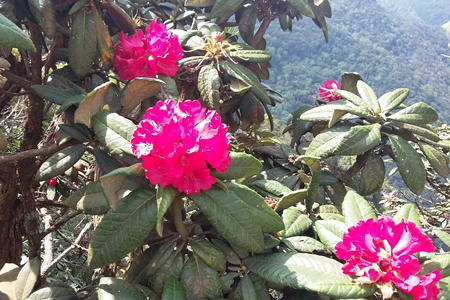
The vegetation is here grasslands interspersed with montane forest, and cloud forest which includes many endemic woody plants. The park can classify into two distinctive groups, widespread montane grassland and subtropical evergreen forests, recorded about 750 species of plants from 20 families which included nearly 54 woody plants, out of half them (27 species) were identified as Endemic to the region. The forest’s canopy reaches a height of about 20 meters. Some of the commonly identify plats are; Rhododendron arboretum, Myrtaceae and etc.
Horton plains is also rich in fauna, vertebrates in the region are recorded as 24 species of mammals, 87 species of birds, 9 species of reptiles, and 8 species of amphibians.

A commonly notify large mammal is the Sri Lankan Sambar Deer known to have a large number of populations roaming in the area (every visit sure siting), the other mammals that could be seen easily when walking in the park are, Purple-faced Langur, Toque Macaque, Grizzled Giant Squirrel and sometimes can see Wild boar, Sri Lanka Leopard, and Strip necked Mongoose too. Also, the park is home to the most endangered animal “The Horton Plains Slender Loris”, Sri Lankan elephants already disappeared from the region the last site was recorded in 1940. Other mammals recorded in the park are; Rusty-spotted cats, Fishing cats, Kelaart’s long-clawed shrew, Sri Lankan spotted chevrotains, Indian muntjacs, European otters and etc,
Horton Plains are also home to some endemic birds of Sri Lanka such as the Sri Lanka Whistling Thrush, Yellow Eared Bulbul are easy to see in the region compared to the other areas.
Among the species of amphibians a frog species “Philautus alto” has been known to be found in the Horton Plains.
Reptiles & lizards found here are mostly endemic to Sri Lanka and some are only found in this region.
The early settlement found in the area date as far back as the stone age, some stone tools have been founded from Horton Plains routing back to early human activities of the stone age. They are related to the Balangoda culture (Mesolithic Period) believe to have oats cultivated in the area.
Natural Attraction at the Horton Plains
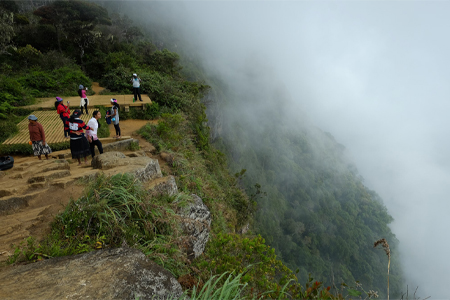
Worlds’ End; is a straight cliff that falls down to 1200 meters right at the southern edge of the central province at Horton Plains. On a clear day, it is possible to the silver line of the southern sea through the neighboring Sabaragamuwa Province. View from the world’s end is spectacular, maybe the most visited place of the park for both local and foreign visitors.
There had been recorded many deaths falling from the cliff due to carelessness, everyone needs to take good care of their footsteps when they visited the place.
Mini worlds’ End; is another cliff that is about 1 kilometer north of the worlds’ end cliff on the walking track of the Horton plains, which is about 300 meters sudden fall also able to see a long way down southern Sri Lanka
Baker’s Falls; a stunning waterfall in Horton Plains National Park on a tributary of the Belihul Oya. The height of the Baker’s waterfalls is 20 meters (66 ft). The falls were named after Sir Samuel Baker, who was a famous explorer.
Knuckles Conservation Forest
Peak Wilderness Protected area *(To be completed)