
Polonnaruwa is the second district that consists of the North Central province together with the Anuradhapura district. It is about 220 km northeast of Colombo using A6 & A11 highways. From Anuradhapura 104 km towards the southeast. The Polonnaruwa District covers an area of 3,293 square km at about 51 meters in elevation extensively. The average temperature is marked at 27 centigrade with a higher humidity level of 85% at a wind speed of 5 km/h. The medieval capital is surrounded by Wasgamuwa National Park, Angammedilla National Park, Somawathiya National Park, Minneriya National Park, and the Kawudulla National Park. Blessed with lots of natural beauty including the mountains of Dimbulagala and Giritale. Enhancing its’ beauty by the huge manmade tanks and the longest river Mahaweli (335 km) and Ambanganga (river) flowing through the Polonnaruwa district. The ancient city and its ruins tell us the story of the glory of Sri Lanka in the 12th century.
History books insist that Mahinda V (young king), the last King of Anuradhapura was not popular among the citizens. It says that the people were often standing against his rule, probably he was a poor leader. With this political background, the city has begun to collapse, and a corrupted deteriorated political background leads to welcoming foreign intervention as usual from south India. *King Mahinda V’s reign from 982 to 993 CE until the Chola invasion. History reports that he had been addicted to alcohol and sensuous pleasure badly opening easy access to the Cola Empire, Raja Raja invaded the country. The Anuradhapura Kingdom fell into Chola Empire and his son Rajendra Raja becomes the new ruler of the country in 1017 CE. He set up Polonnaruwa alias Pulasthipura as his capital and neglected Anuradhapura from diplomatic involvements letting the city become extreme deterioration with activities of disorderly mercenaries and local soldiers, while they brought numerous Hindu influences into the country, Chola Empire and after their followers ruled northern parts of Sri Lanka as a province of south India until the Southern Prince Vijayabahu (born 1039-died 1110) bring back the Sinhalese power in the year 1070 CE. After his successful war against the Chola empire, he united the country again ending over six decades of foreign control.
The Warrior Prince Kitti [ Keethi] later become King Vijayabahu in Rohana or southern Sri Lanka when he was 16 years old in the year 1055 CE and had to face many battles including local competitors. After defeating all the enemies, he succeeded the Warrior King of Sri Lanka. Polonnaruwa City remained unchanged the King was crowned as Vijayabahu I. He chooses to rule from Polonnaruwa, then after the city was named Vijayaraja Pura, the new King developed the City into a sophisticated place to live. With his mightiness, he ruled the country until his death in 1110 CE for 55 years. His successors, his brother Jayabahu I ruled for a short period of less than one year, and after taking the throne by Wickremabahu I (son of Vijayabahu I) followed by Gajabahu II who was the son of Wickramabahu I, all remain in the chronicle as kings but with no credits. They had been failed kings who they were failed to follow the Great Vijayabahu I s’ political stability to maintain the unity of the country. It was a period in the country’s unity, prosperity, and growth were in great danger until the year 1153 CE when, as a grandson of Vijayabahu I become the King “Parakramabahu I the Great”, after having a series of battles with many competitors.
Polonnaruwa reached its best period with the succession of king Parakramabahu I the Great, who ruled the country until his death from 1153 – to 1186 CE. Prosperity & fertility astonishingly grew up following his agendas for massive town planning, water management & socio-cultural and economic developments. After his death, the golden era of Polonnaruwa was recorded until the throne of King Nissankamalla (1187-1196), who was a son-in-law of Parakramabahu I.
After the death of Nissankamalla his son Virabahu I was crowned but slain on the same day on his bed. The game of power and the craving for power continued within the family. Kings and queens who ruled, ruined the country until the foreign invasion comes in to conquer the power of Polonnaruwa. It was an easy task for south Indian Pandyans to attack the island, A Pandyan King ruled for 3 years from 1212 -1215 CE (Parakrama Pandya). And later Kalinga Magha of south India conquer the Polonnaruwa after having a massive attack in 1215 CE. He killed them all and ended the House of Vijayabahu. This was the time that Kalinga Magha founded the Jaffna Kingdom letting grow Tamil power in the north of the Island.
Polonnaruwa was too young to be disappeared and existed as the Capital City of Sri Lanka for only about 145 years. Gradually the city begin to collapse, and common people moved into the south and western interiors more than ever in Islands’ history. The Great City slowly turned into a thick jungle and was hidden behind for centuries. After the end of the rule of Kalinga Magha (1215-1236 CE), Sinhalese Kings from Dambadeniya (Official Third Capital City) had been tried to move to Polonnarauwa again a few times in history but couldn’t change the fate of Polonnaruwa. All glory of the city is hidden behind the forest forever, just leaving us some evidence to explore about the UNESCO World Heritage Archaeological City of Polonnaruwa. Declared a world heritage in 1982.
The great city Polonnaruwa turned into a thick jungle for nearly 700 years, until official action is taken to discover the dead cities of Ceylon during the time of the British Governor Sir Hercules Robinson (1865-1872) in the second half of the 19th century in the Kingdom Queen Victoria (1837-1901).
Firstly, appointed a committee to collect information on the ancient architectural works of Ceylon. In 1871, an excellent series of photographs were taken of the principal structures of the Anuradhapura & Polonnaruwa. And further, under the instruction of Governor Sir William Gregory pioneering work was carried out by J.G Smither and released comprising information of certain monuments in ruined and Dagabas (Pagoda) titled “Architectural Remains of Anuradhapura” completed in 1894. A team of epigraphy led by Professor P Goldschmidt and E. Muller with Maha Mudaliyar W.E.D Zoysa carried out work in searching inscriptions and original records of ancient Ceylon.
A supervisor was appointed, Mr. S.M. Burrows (of Ceylon Civil service 1884-1886) for archaeological matters for Anuradhapura & Polonnaruwa. Jungle started to be cleared gradually, roads were restored, new access roads were constructed, drawn up new schemes for further excavations and implemented conservation projects, and museums were opened for the preservation of sculptures and paintings.
Preliminary investigations had been continued with an appointment of Mr. H.C.P Bell (of Ceylon Civil Service) as the Director of Archaeological matters on the 7th of July 1890 during the Governor Sir Arthur Gorden. The date is considered the birth of scientific archaeology on the Island.
By; K Eranga Suneth Jayasinghe
(* Some Ref: Tooth relic and the Crown by Dharamaratna Herath), # Mahavamsa, # Archarelogical department info.
Places to Visit

Parakrama Samudraya (Reservoir)
Parakrama Samudra or the Sea of King Parakramabahu I is a shallow reservoir the deepest point is about 25 feet at present after restoration in 1937. It originally consisted of five separate reservoirs Thopa weva, Dumbutulu weva, Erabadu weva, Boo weva, and Kalahagala weva by the names of them. It is said that all these reservoirs are interconnected by narrow channels and erecting hard a common bund creating the biggest and most massive reservoir on the island. Apart from the rainwater, the reservoir has been fed by two main water resources. The main source is the Amban River, a tributary of the longest river Mahaweli, and the second is through the irrigational canal Elahara to Giritale lake, from Giritale to Tambla lake, and to Kadawala lake, and from Kadawala to the Parakrama Samudra.
It is unfortunate that the old technic of carrying water to all these five tanks has been missed managed during the restoration in 1937 and now only 3 tanks are presence as the Parakrama Samudra. The Boo weva and Kalahagala weva has been neglected and now they are back in the jungle. Not only this missed technology but also changing the original spillway had been stopped the use of the excess water to fill more tanks around through the old canal set up, and now the excess water back in the Mahaweli river to then to the sea without using them.
Features of the present, Bund 12.38 km long at a height of 9.45 meters at max point. The catchment area is 71.71 square km at a full capacity of 134.07 million cubic meters. Dead storage 184.5 million cubic meters. The irrigable area is 7993.2 hectares
Pothgul Viharaya

There is an argument about the name of this building which hasn’t been clear what exactly it was with the current evidence found on this ruined. There was a suggestion this could be either Kapila Vihara or Mandala Mandira built by King ParakaramaBahu I the Great 1153-1186 CE. Not sure of the present name Potgul Vihara, and how it drives from, however, if this was the Potgul vihara or the library shrine could be regarded as the oldest library shrine so far found on the Island.
Archaeologists have found a stone inscription at the site belonging to Queen Chandrawathie consort of King ParakaramaBahu I the Great recorded their renovation work at this temple.
The peculiar feature of this site is the circular brick building like a Pagoda located in the center of the squired central terrace. Evidence suggests that the roof itself had been made out of bricks and the inner wall’s plaster contained paintings. On the four corners of the building four circular mounds are seen which may be the associated stupas or pagodas, and on the lower terrace are seen rectangular or squire residential cells. Shrines of similar design are seen in South East Asian countries and this particular site is very much closer to the Minbien Shrine of Cambodia, as explained by scholars.
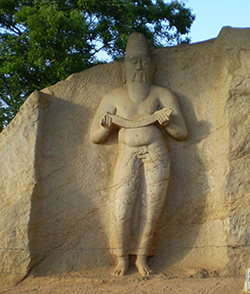
Statue of King Parakramabahu I The Great
Traditionally it is believed that this statue is of King Parakramabahu I the Great in 1153-1186 CE. However, there is no evidence to prove and confirm the tradition in which some scholars are believing that this might be a statue of Sage who lived during the Polonnaruwa period.
Concerns are taken place with the object carrying on both hands could be a palm leaf manuscript where should then be one of these sage Pulasti, Agastya, or Kapila representing their erudition.
The common version is that King Parakramabahu I is holding a yoke representing sovereignty.
My personal opinion is that this could be a message that how the reading is improving the knowledge. And if this area was a library complex, may have been decorated with influential objects, sculptures, statues, etc. The statue could be the King or a Sage.

The palace complex of King Nissankamalla
Another brave character, King Kirti Sri Nissanakamalla has left many records of his ruling in Polonnaruwa. He is the successor of King Vijayabahu II and the nephew son of King Parakramabahu I the Great. Uniquely creative King has made many Buddhist temples and done numerous developments around the Island during his short ruling period from 1187 till 1196. The picture is of the ruins of his palace complex by Parakrama Samudra in Polonnaruwa. The lion figure in the Royal council hall is where King was seated during the meetings and inscriptions on the pillars explain that ministers were given places to sit on the premises. The palace complex is consisting a Royal palace, opened bathing area, a council hall, and maybe more which may have despaired with time goes on.

Archeological Museum Polonnaruwa
The museum is located near the main sluice gate of the Parakrama Samudra. It was designed for two purposes; To exhibit artifacts that were recovered through explorations, excavations and research carried out since 1981 by the Ālāhana Project of the Central Cultural Fund and to provide a piece of sound knowledge and understanding to the visitors about the Polonnaruwa World Heritage Site. The museum was opened for exhibition to the public on 31st September 1998. The Government of the Netherlands provided aid for the establishment of the Polonnaruva Museum, while Dr. Ruloph Monake, Curator of the Leiden Museum in Amsterdam, Netherlands also made contributions.
The fundamental concept of the Polonnaruwa Museum is to help the visitor easily understand the ancient urban plan of Polonnaruwa and the monuments within it. The gallery plan starts from the urban center and proceeds toward the hinterland.
The picture is the model of the Palace of King Parakramabahu I the great.
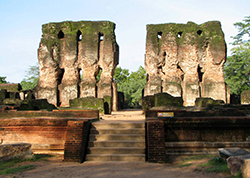
Royal Palace complex
This is the ruins of 7 story palace of King Parakramabahu I the Great (1153 to 1186 CE). The massive building burned into ashes when the Kalinga Maga attacked the city. Only the center of the building walls is still on the stand. The remaining walls are thick as 7 feet, the original structure may have been designed with granite, bricks, and wooded with the copper roofing and etc. When walking onto the ground level, there are many small rooms that can be seen, some say they could be the Royal treasury storage rooms. And can see a very wide granite stairway the up. A clearly visible vertical and horizontal opening on the walls must be the evidence that proves how the architecture used the wooden pillars and beams to set up the floors. Except for the tall walls that exist, there is a very wide area covered including bathrooms and other parts of the building which only can see the foundation of the structure.
Kumara Pokuna
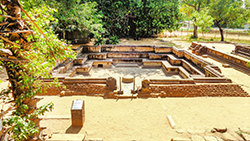
Royal Pool, designed at a lower level east of the palace complex of Vijayabahu & Parakrabahu. A square-shaped bathing pond may have been designed to enjoy sitting around at two levels. On the west side there is two dragon mouth by the sides of stairways to the pond proving evidence of constant water supply, and at the bottom on the east of the pond can see a hole for water outway from the pond. And ruined monument next to the pond on the south is the evidence of a royal changing room by the pool.
Parakramabahu Council Chamber

The ruined Council Chamber can be seen between the Royal palace and Kumara Pokuna. Completely made out of solid granite with skilled carvings of elephants, dwarfs, and lion figures around the central part of the remaining building. Staircase decorated with a moonstone at the entrance and Korawakgal (Dragon figure Stone) on both sides at two levels, with stunning welcoming two lions placed at the doorway to the main chamber room. The roof of the building may have been set up on the granite pillars which you can see some of them are still existing with their lovely carvings. The technology here to identify is the accuracy of the glue that they used to attach the granite.
Siva Temple 1

The Shiva Temple (No 1) is located in Polonnaruwa old city between the Royal Palace complex and the Quadrangle or the Sacred Tooth Relic Temple premises. The builder of this Hindu Shrine is not clearly identified. But it is believed that this was constructed in the 13th century by south Indian invaders because the architectural style of construction is very similar to the Pandian architecture in south India and of cause, south Indians ruled here for a long period.
The large lingam found here in the ruined building is the symbol of Lord Shiva and had been taken to the National Museum in Colombo. It was discovered during excavation work started to restorative the old city.
The building was completed mainly with the stonework, which was done very precisely, and no mortar was used to connect the stone bricks to each other.

Thuparama Temple
Take a look at the top pictures of the Thuparama image house, the sketch is the original building that was imagined after it was founded badly damaged, and the picture below is after it was preserved.
Inside the temple, there are 4 damaged limestone statues of Buddha, and the main statue at the right end of the shrine room was completely demolished. The building was originally designed with murals and images of Buddha. Not known who take the credit to build this without proven evidence although one could think of King Vijayabahu I or King Parakramabahu I who were patronage Buddhist temples. The original name of the image house has not been identified yet.
This building and other ruined buildings are set on a limited square piece of land at where highest altitude in the area. It was simply a complete temple complex including Bo-tree, relic house, image houses, and chapter house.
Experience a modern temple to imagine the model of this temple complex.
Atadhage
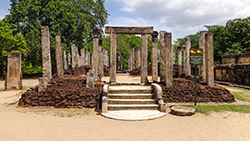
The Sacred Tooth Relic of Lord Buddha was brought to Lanka in the early 4th century during the reign of King Kirti Sri Meghavanna (301-328 AC). The relic was kept in Anuradhapura with a great honor under guardians by all rulers until the end of the Anuradhapura monarch. The tooth Relic was secretly moved into the south of the Island from Anuradhapura for its’ protection. Vijayabahu I The Great (1055-1111 CE) demolished the south Indian Chola power who ruled for over 77 years.
The new King built this Tooth Relic Temple on this grounds and this is the first Tooth Relic Temple in Polonnaruwa. It was a two-story building but only could see some ruined pillars and the basement of the central parts of the building today. Slab inscription set on the left of the ruined building is written down in the Tamil language, and it is explained that King was using south Indian specially trained soldiers to protect the Relic temple.

Watadhage
Beautifully designed Relic House. There is evidence that can see brick remaining of a Tupa at the right-center of the building and four Samadhi Buddha statues around the Tupa facing 4 sides. The overall structure is a circle shape and with umbrella shape wooden roofing holding on granite pillars. The most beautiful monument found very badly damaged is known to have the work of King Parakramabahu I (1153-1186 CE). Now restored at its best level although not improving any restoration further which may implement more nicely with modern technology.

Hatadhage
The newer Tooth Relic temple was built next to the Atadhage. This was built by King Kirthi Sri Nissankamalla in his reign (1187-1196 CE). The two-story relic house was designed to honor the Tooth Relic in a peculiar way, the architectural design and the engineering mechanism were somewhat different to all other structures found around, no specific shape in granite stones was used to construct the structure but they were fixed together in a unique way to attach each other. Some damaged Buddha images were restored in positions in the inner chamber on ground level, and some of the interior designs beautifully remained yet. And those are telling us some evidence of the marvelous beauty of this temple at the time that this temple was built. Finally, the best of the construction of this building is the time of completion, it is explained that completed within 60 hours bringing its’ name the Hatadhage.
Stone Book [ Galpota ]

Stone inscription by King Kirthi Sri Nissankamalla could be the world’s biggest inscription that was ever found. The rectangular stone book is decorated with beautiful carvings of swans around the stone and carved out a charming figure of Goddess Lakshmi holding lotus flowers from both hands under the shade of two elephants on two sides of the stone book. There is a written notice on this book, that this huge piece of rock has been brought down up to here from Mihintale in Anuradhapura for this purpose. The stone book is 27 feet in length & 5 feet in width containing 4000 letters in 72 rows. The information translated from this inscription is most about the history of the King’s family and the wars he succeeded against the south Indian invaders. This inscription is truly valuable for a person who studies the ancient Sinhala language.
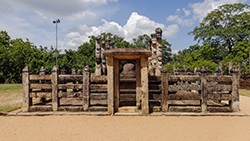
Nissanka Latha Mandapa
The Chanting chamber of the Dhaladhamaluwa illustrates the uniqueness of each architectural design of King Nissanakamalla. Except for the roof total work has been made with skilled granite carving technique. The fence, platform inside, symbolic Tupa on the center of the platform, and extraordinary pillars erected to hold the wooden roof. Each pillar is about 8 to 9 feet in height and looks like they are representing lotus sticks which they might have designed in holding an astonishing lotus roof of this marvelous creation.
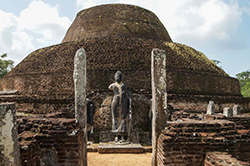
Pabulu Viharaya
The chronicle Tupawamsa recorded that this Tupa was constructed by instructions of the Queen Rupawathi, a consort of King Parakramabahu I the Great. The architectural plan is not very clear or might have ruined its original structure when the restoration works were done later by other rulers. Baked bricks and granite had been used to set up the rare structure of a two-story pagoda. The Buddha statues and some flower offering rooms set up around the Tupa were not in order with the general designs of the tradition found in any other similar monuments. It might consider a corrupt political influence that may ruin the traditional values of maintaining temples. Like in present-day, adding unwanted, unmatched parts to public properties just for a purpose of becoming popular among the general public.
Not many visitors take attention to this monument but must visit and discover what I explained above regarding this monument. The name PABULU means beads, and not sure why this is Pabulu Viharaya. Probably the sands on the ground around were special shapes like beads as to the folklore or maybe a completely different reason such as the beads necklaces found at the site during the excavation for the restoration of the monument.

Siva Temple 2
This Siva temple was built during the time of south Indian Emperor Raja Raja. His son Rajendra Raja was the ruler after the invasion in 993, and it is explained in history books that he had built this Siva temple to commemorate the victory against Lanka and to honor his mother “Wanavanma Ishwaranm” This is the oldest Hindu temple in Polonnaruwa, which the building premises are on a 20 feet square land plot, complete with granite interlocking stone bricks including its’ roof, which this style is known to be the “Gedige” (a building with its own brick roofing) tradition of Chola Architecture. Comparatively small but the only monument that still exists with its original shape of the roof.
Not sure if the remaining building is just a shrine room inside the bigger temple which may have disappeared today, where the Nandhi (Bull figure) is outside the shrine room of the symbol of Lingam & Yoni (Penis & Vagina) of the god Siva and the consort Parvathi, where normally set up the structure in a bigger house. The model could be seen in modern Hindu temples.
Manik Vehera
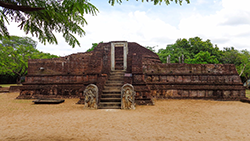
Polonnaruwa had been known as the sub-capital of Anuradhapura and used to keep the extra army from very early days. And the city is the gateway to the northern part of the island from the south in old days. Therefore, the Polonnaruwa is a strategically important location, and most Kings have given full attention to the Polonnaruwa. All South Indian invaders choose Polonnaruwa due to this reason, simply they can stop attacks rather easily from the south when river crossing.
This temple complex is a complete monastery, including facilities of a hospital, refectory, and all monuments of a basic Buddhist temple such as Tupa, Bo Tree, Image houses and etc. It is believed that this temple was built here during the Anuradhapura period probably in the 8th and 9th centuries. The remaining ruins of this temple leave us something to imagine what has happened there centuries over centuries. Not clear who and when was the temple built.
Alahana Pirivena Complex

The Alhana Pirivena complex has been built on a series of rocky terraces away outside of the Citadel of King Parakramabahu I the Great. The King had re-organized the development of Buddhist monasteries, he built numerous temples including this Buddhist university. The history books say that there were over 2000 student monks studying at a time. The complex was completed with all facilities, private rooms stay, washrooms & Toilets, refectory, hospital, Rankoth Vehera south to the pirivena, 12-story Baddhasima Pasada and the Lanka Thilaka image house included for the benefit of those students. The largest university was founded after the Anuradhapura era. It is said that King chooses to build on a graveyard of aristocrats and chief incumbents were cremated, which is clearly visible by the existing tombs at the north end of the complex.
Rankoth Vehera

Tallest Tupa in Polonnaruwa, 33 meters in height on a solid basement. The diameter of the Tupa is 170 meters. Built-in later 12th century by King Nissanakamalla. The Tupa know as the Swaranamali Tupa of Polonnaruwa (Replica of Swaranamali Anuradhapura) in early days. The present name Rankoth Vehera referred to its golden pinnacle but couldn’t see the pinnacle anymore
Gopala Pabbatha

This rocky cave is situated between Alahara Pirivena & Rankoth Vehera. The archaeological inscription found at the site mentions that this belongs to the 1 to 2nd centuries BC by its inscribe Brahmi letters and the old Sinhalese language used, and it is mentioned that donated to the Chulagala Temple by Chula Ahalaya son of Ayatiya Buta. Having concerned this message it is clear that there was a monastic temple long before the Polonnaruwa Alahana Pirivena complex come to an existing.
Bikku Hospital

12th-century hospital built on the lands between Alahara Pirivena and Rankoth Vehera by the west of Gopala Babbatha cave. The hospital is very similar to the one found in Mihintale built in the 8th century. During the excavation at the site has found medical equipment such as surgical scissors, medicine grinders and etc, also it is clearly visible that the oil medicating stone boat is still on the site.
Badda Sima Prasadaya
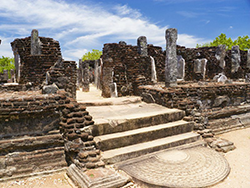
According to the chronicle Chulawamsa, King Parakramabahu I the Great built this 12-story building within the Alahana Pirivena complex to insure that all monks of the pirivena are periodically practicing their confession. At every two weeks time, all ordinated monks gather for the pohoya karmaya. Pohoya karamaya is that every ordinated monk has to participate in the regular self-evaluation of their behavior, discipline, and other restrictions tide-up to continue as a monk. If a monk is guilty by heart he could confession and ask for a punishment or may be entitled to forgiveness but insuring not to do fault again. A higher ordinate monk will take the lead of this regular Pohoya Karama. The length of the building is about 113 feet and the width is about 106 feet.

Lankathilaka Viharaya
This amazing Buddha image house was built by King Parakramabahu I the Great. Archaeologist Professor Senarath Paranawithana suggests that this building consists of 5 stories and is tall up to 100 feet. The exciting features of this building were designed by using different shapes and different sizes of bricks and lime plaster. At the deep end of the building, the image of the Blessing posture of the Buddha is in badly damaged condition, said to have been robbed off all of the treasures enshrined, by looters, In the first particle of the shrine room has two steep stairways from both sides for lifting to upper levels of the Shrine house. Total Shrine had been decorated with gorgeous deities, other traditional carvings, and colorful murals of the Buddhist tradition. Professor Paranawithana, also believes that this building has been renovated during the years 1270 and 1272 CE.
Kiri Vehera
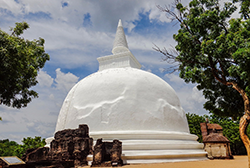
The Tupa was known before as Rupawathi Tupa, The name is one of the consorts of King Parakramabahu I the Great’s queen Subaddra Rupawathi. It is said that the queen built this Tupa after the death of the King.
When discovering the Polonnaruwa dead city, this Tupa was in considerably good condition. Some parts of the original plaster around the Tupa can be seen even today. And on the surrounding grounds, there are a few more Tupas with oval shapes,
Galviharaya

Uththaramaya ( Northern Temple) was the original name of this extraordinary stunning creation of Lord Buddha’s Life story with just four statues. The original structure of the building has disappeared without any trace. Only could see the foundation bricks of the building in front of the associated huge piece of carved granite. This phenomenal sculpture tells the story of the big skilled heart of the craftsman, the creator must have imagined the Buddha-hood by his heart to present us with the images of Lord Buddha. If I am reading him in my own way, the huge statue in deep meditation depicts the moment of ascetic Siddhartha Gautama became the Buddha Hood. Even though he became the greatest of all kinds, yet he has spent his life like a normal man. Try to expose his humbleness from the smaller statue in the cave room where Buddha is spending his whole life preaching Noble Truth Dharma for the intelligence of both humans and Gods. And the next unfamiliar posture of Buddha, was when Polonnaruwa’s old city was discovered has had many complicated illustrations about the statue. For me, the Lord Gautama Buddha looks at the creatures of the endless universe to bless them to lead to be free from the sufferings of life cycle. And at the end, a huge reclining statue depicts the Lord Gautama Buddha resting in endless Nirwana forever.
Temple was built by the order of King Parakramabahu I the Great. On the granite wall can be easily found an inscription from the King who had clearly mentioned the monks’ law and order to be practiced all the time and other information about his patronage temple.
Lotus pond
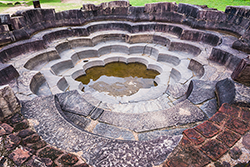
This unique Lotus flower shape pond is found in an open area on the left side of the road way to the Thiwanka Pilimage image house (Former Jethawanaramaya) . The pond has a diameter of 25 feet and the height from top to bottom is 4.6 feet. craftsman designed a blooming lotus using pure granite and supported the structure to hold its petals with burned clay bricks. In the excavation project carried out in the area, it has been found similar ponds at close proximity. It is believed that this was a temple gardening design by King Parakramabahu I the Great.
Thiwanka Pilimage

This is the Buddha image house of the Jethawanaramaya temple that existed in Polonnaruwa. This temple was also built by King Parakramabahu I the Great during his reign. The present name is taken to it by the rare shape of the main Buddha image. Outside of the image house is beautifully decorated with lion figures, dwarfs, and the means of different heavens by limestones and completed with fine chalk plastering.
Polished white walls inside the building, are painted with fine paintings of previous life stories of Buddha (Jathaka Katha). More a painting of the dream of Buddhas’ mother, a painting of returning from the heaven after preaching Dharma to the Gods, and a painting of the request from other gods to come to earth when the Buddha lives in Thautisa Heaven as a God before this life.
By Eranga Suneth Jayasinghe