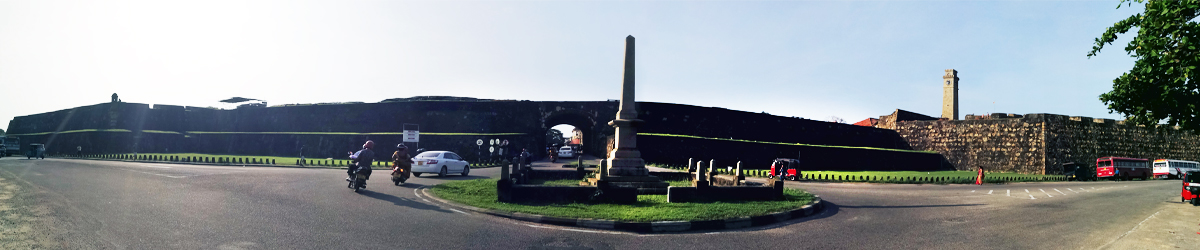
Galle situated approximately 120 km south of Colombo, is the administrative capital city of the southern province of Sri Lanka, the city is well known to the world as a World Heritage city of Dutch Fortress. It is said that the first European was Portuguese led the fleet by Commodore Lourenco de Almeida in November 1505 CE. The arrival of the vessel seems to have been accidental by a storm to the Galle harbor, and after they anchored the vessel in Colombo harbor to meet the local King of Kotte probably at the beginning of the year 1506 CE. The Galle Fort was started built by the Portuguese in 1588 when they gradually expanded their authority in trading in most of the coastal areas around the island until the arrival of the Dutch in 1640 CE.
In mid 17th century, Dutch occupied the fortress and developed it further with unique architectural designs followed by high-tech engineering to manage the drainage waste, built Star bastions facing sea sides and the Sun & Moon bastions on the land side for fort security and well-maintained warehouse to store spices and other exports of East Indian Trading Company. Dutch fortress was the main administrative city until the British Empire took over it. Britishers reconstructed the walls making them taller as to the present day of the fortress but gradually choose the administrative city for the Colombo fort. Today Dutch fort is an alive village with lots of memories of history.
Much older history of the Galle harbor goes back as far as the King Solomon period, according to Sir James Emerson Tennent (British Politician) King Soloman used the Galle harbor to transport Elephants, Peacocks, and Gemstones from Sri Lanka. Also, the traders from ancient Greeks, Persians, Arabs, and Chinese have been used Galle Harbor long before the Europeans occupied the city.
By Eranga Suneth Jayasinghe
What is interesting inside the Fortress? Some of them are,
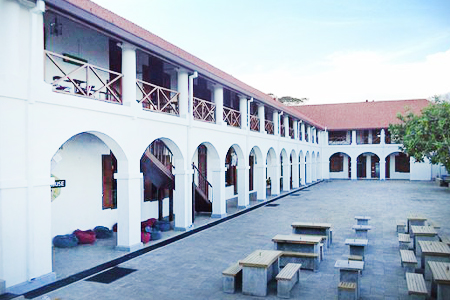
Dutch Hospital
A two-story beautiful shopping arcade by the harbor side of the fort next to the Galle High courts is said to have been the Hospital complex during Dutch rule. The building was neglected for over a few decades until 2006, then call a total conservation project with the support of the international council on monuments and sites for fundraising from WMF (world monuments fund). Restoration work was carried out by the Urban Development Authority with the assistance of the 10th Engineering regiment of the Sri Lanka Army and was completed in 2014, and open to the public on 20th September 2014.
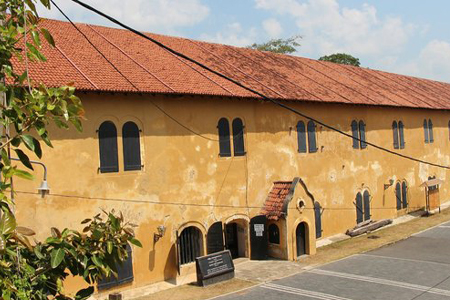
Maritime Archaeological Museum
In 1717 CE, The odd-looking two-story building designed with thick walls built on the northeast of the fortress by the harbor side might expect easier access for transport goods to and from the harbor as the building was originally a warehouse of the Dutch East Indian Company. Original access to the fort was through the warehouse building but changed the main entrance by English leaving the old gate negligent. The building was occupied as an administrative office in the post-independent period for some time and after not utilized until it was converted into a Maritime Museum in 1992. However, the museum was devastated by the Tsunami in 2004 and rebuilt the museum obtaining financial aid from Netherlands Government, and opened to the public again in 2010.
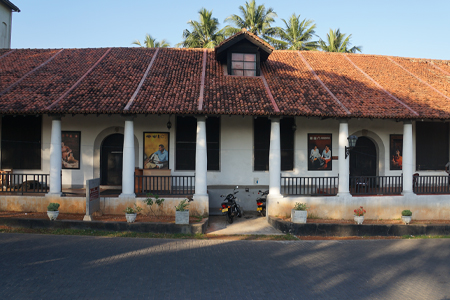
National Folk Museum
The oldest Dutch building in the fortress was converted into a museum and opened to the public on 31st March 1986. This building is said to have been constructed in 1656 during the Dutch occupation, it is simply an old stylish building that had been used for various purposes before.
The objects displayed in the museum are mostly archaeological and anthropological important to examine the inheritance of the southern region.
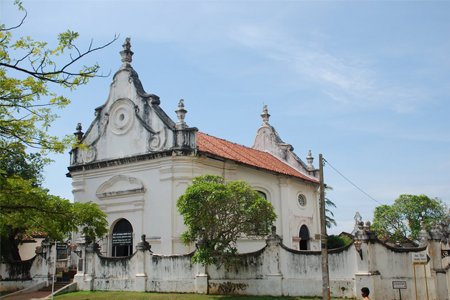
Dutch Reformed Church
The church was built on the highest elevational point in the fortress’s natural landscape facing the Harbor at about 12 meters above sea level. It says that the foundation bricks were laid long before the opening of the church in 1755 CE. The initial foundation was laid in 1682 and after construction work delays a few decades until a Dutch Commandeur Casparus de Jong’s donation to build the Church. Since then the church service continues till today.
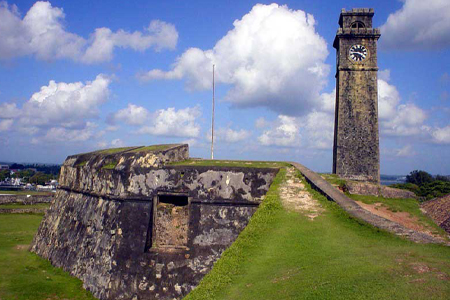
Clock Tower
Clock tower erected at the inner side of the moon bastion, 83 feet tall tower built and opened in 1883. The total cost of construction was paid by the public funds and the Clock machine was the sole gift of a grateful patient, Mudaliyar Samson de Abrew Rajapakse.
The clock tower inscription; “This tower erected by public subscription to the perpetual memory of Peter Daniel Anthonisz (born in Galle) in the testimony of his skill and benevolence in relieving human suffering. MDCCCLXXXIII”
Peter Daniel Anthonisz was a renowned Dutch Doctor (1822-1903) who served as the Colonial Surgeon for the Southern Province and as a representative on the Legislative Council.
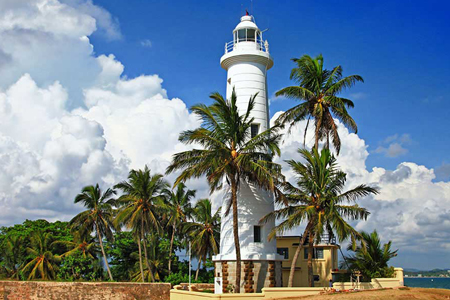
Lighthouse
Galle lighthouse known to have the oldest on the island built in 1848 by the British at the southwest bastion of the rampart, was destroyed by a fire in 1934 it was tall at 80 feet by the tower and 100 feet at the focal plane.
It has been replaced by a newer lighthouse on the southeast bastion completed in 1939 before the independence of the British. The Lighthouse tower is taller at 87 feet and the focal plane is set at 93 feet height. In active aid navigation, two white flashers flash every 15 seconds ranging 25 nautical miles.

Amangalla Hotel Building / New Orient Hotel
The older part of the building was completed in 1684 and had completed the complex in 1715, known to have been the headquarters of the Dutch military and then in English also used the building to accommodate their army soldiers.
After all, in 1865 the building has converted into a hotel as the “New Orient Hotel” to cater to travelers who travel from Europe at the time. It existed for 140 years until Aman Resorts took over in 2005. Amangalla is a 5-star franchise hotel belonging to the international group of Aman Resorts.
By Eranga Suneth Jayasinghe